tarsk
A Python task queue whose workers hold a memory ceiling you set — without losing a task.
task with rust through the middle. The scheduler, retry state machine, lease tracking and
child supervision are Rust; the only Python in the hot path is your handler.
pip install tarsk            # memory broker only
pip install tarsk-redis      # + Redis Streams
pip install tarsk-postgres   # + Postgres
pip install tarsk-amqp       # + RabbitMQ
Pick one. Same tarsk, same tarsk package, one broker compiled into each — installing
two leaves you running whichever pip unpacked last, so tarsk refuses to import when it
finds more than one. Upgrading from 0.1.x, where pip install tarsk carried all of them,
is a breaking change: see the
changelog.
from tarsk import App

app = App(broker="redis://localhost:6379/0")

@app.task(retries=3, timeout=30, queue="heavy")
def embed_document(doc_id: str) -> dict:
    ...

task_id = embed_document.send("abc")
tarsk worker --app myapp:app --broker redis://localhost:6379/0 \
             --queues heavy --children 4 --max-rss 400MB --metrics 0.0.0.0:9090
Handlers must be idempotent. Delivery is at-least-once. This is a contract, not a footnote: a worker killed mid-task will run that task again.
Pages
| How it works | The shape of a worker, where your imports land, what runs where |
| Writing tasks | Timeouts, soft timeouts, retries, expiry, deduplication, rate limits, concurrency caps |
| Routing and scheduling | Queue priority, brokers, chains and groups, cron, the async producer |
| Operating | The console, metrics, the backlog, dead letters, cancellation, the test suites |
| Benchmarks | Against Celery and taskiq, including every column where tarsk loses |
The claim, in one chart
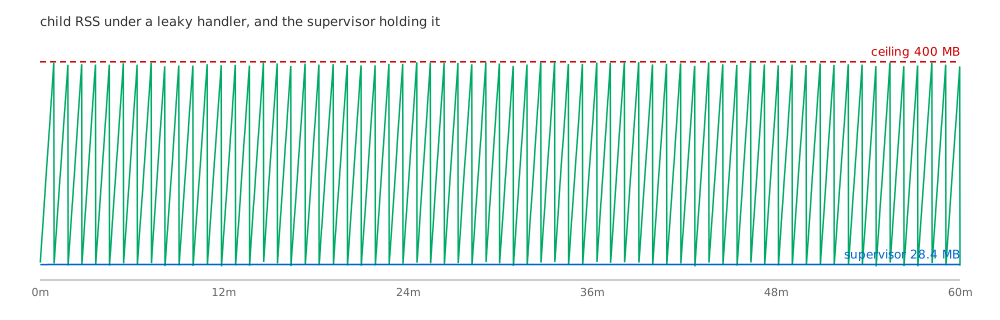
One hour, 72,001 tasks, a handler that never frees anything. 66 recycles, peak 400 MB against a 400 MB ceiling, no sample over it, nothing killed, nothing lost.
The sawtooth is the children being held under the ceiling. The flat line beneath it, on the same axis, is the supervisor doing the holding — 28.32 to 28.40 MB across the hour, a drift of 82 KB. A ceiling enforced from inside a process with the same problem would only defer it, so the enforcer staying put is half the design.
Reproduce both with python demo/run.py, which exits non-zero if the supervisor drifts.